
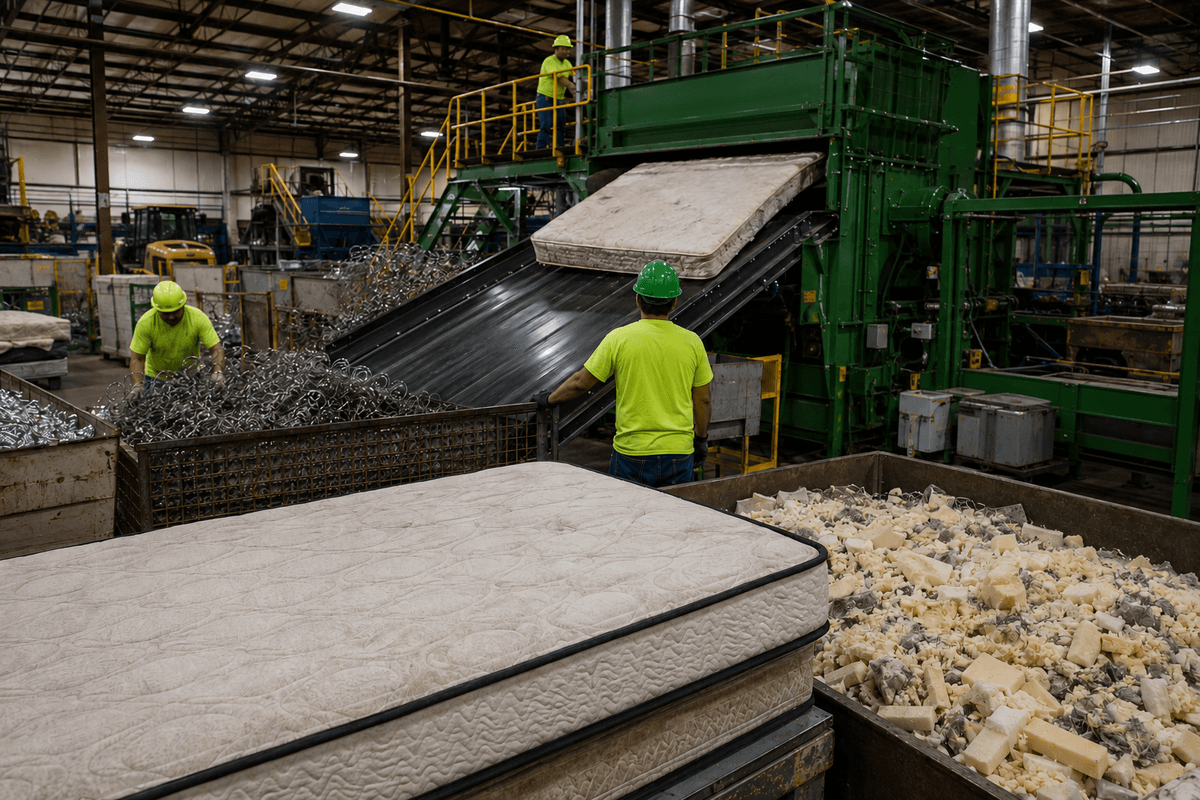
You have an old mattress sitting in a spare bedroom or out in the garage, and you are wondering what actually happens to it when it gets recycled. The foam, the fabric, the wood frame — those feel pretty intuitive. But the springs? A tangle of steel coils buried inside a queen or king mattress does not exactly scream "easy to recycle." If you are in Leander, TX, and searching for a straight answer, you found the right page.
This guide breaks down exactly what happens to the metal springs inside a mattress once it leaves your curb — the process, the why, and the difference it makes when you choose recycling over dumping. By the end, you will know more about mattress steel recycling than most people in Williamson County ever will, and you will have a simple next step if you need that old mattress gone.
Why Metal Springs Are the Trickiest Part of Mattress Disposal
A typical innerspring or hybrid mattress contains anywhere from 300 to over 1,000 individual metal coils, depending on the size and coil count. That is a significant volume of steel — but it is steel that is tightly bound in fabric pocketing, stapled to a border wire, and sandwiched between layers of foam and batting. Getting to it requires physical labor and the right equipment.
This is exactly why mattresses end up illegally dumped along roadsides or tossed into landfills whole. Most curbside recycling programs will not take them. Many transfer stations charge steep fees. And the average homeowner certainly is not going to take apart a king mattress by hand to separate the steel from the fabric before hauling it somewhere.
When you work with a dedicated mattress recycling pickup service in Williamson and Travis Counties, that problem is solved for you. The mattress goes to a facility where the disassembly actually happens.
The Anatomy of a Mattress Spring System
Bonnell Coils
The classic hourglass-shaped coil found in many traditional innersprings. Bonnell coils are interconnected with helical wires, creating a continuous steel grid. They are durable but bulky, and the interconnected design means the whole unit has to be untangled or cut apart during recycling.
Pocket (Marshall) Coils
Each coil is individually wrapped in a fabric sleeve — usually a non-woven polypropylene or polyester casing. Pocket coils move independently, which is great for sleep, but it means recyclers must cut or tear the fabric from each individual coil before the steel can be processed. More labor-intensive, but still very recyclable.
Offset and Continuous Coils
Offset coils have a flattened top and bottom that link together in a hinge-like fashion. Continuous coils are formed from a single piece of wire that zigzags across the entire mattress. Both configurations are found in mid-range innerspring mattresses and both yield recyclable steel — just in different shapes and wire gauges.
Micro-Coils in Hybrid Mattresses
Hybrid mattresses have exploded in popularity across Austin, Leander, Cedar Park, and surrounding areas. Many of them contain a layer of micro-coils — tiny, individually pocketed coils sandwiched between foam layers. These are steel too, and they can be recycled, though separating them from dense foam requires more careful processing.
Step One: Collection and Transport to the Recycling Facility
The process starts the moment a mattress is picked up. Whether it is a twin mattress pickup in Liberty Hill or a king mattress pickup from a Leander neighborhood, every collected mattress is transported to a dedicated processing facility — not a general landfill, not a junk yard, and not a dumpster behind a strip mall.
At the facility, mattresses are sorted by type and size before processing begins. Sorting matters because a memory foam mattress with a minimal coil system is processed differently than a heavy-duty queen innerspring with 800 Bonnell coils and a solid border wire perimeter.
Step Two: Outer Fabric Removal
Before any spring can be recovered, the outer fabric layers have to come off. This is where the work begins. Facility workers use box cutters, hook blades, and hand tools to cut along the edges of the mattress and peel back the quilted top panels, the border fabric, and any pillow-top layers.
- Quilting fabric and ticking (the outer cover) is separated and sorted for fiber recycling or repurposing.
- At Williamson County Mattress Recyclers, clean fabric is specifically set aside for a unique purpose — it gets repurposed into comfortable dog beds donated to local animal shelters.
- Foam batting and comfort layers are removed and baled separately for foam recycling.
This step sounds simple, but on a stained, compressed, or damaged mattress it can take real effort. That is part of why dedicated mattress recyclers exist — this kind of disassembly is not something a standard recycling facility is set up to do.
Step Three: Spring Unit Extraction
Once the comfort layers are stripped away, the spring unit is exposed. For most innerspring and hybrid mattresses, the spring unit is a self-contained assembly — a rectangular grid of coils bordered by a thicker-gauge perimeter wire, all stapled or tied to a wooden or metal border frame.
Separating the Border Wire
The border wire is heavier-gauge steel running around the entire perimeter of the coil assembly. It is cut free using wire snips or bolt cutters and kept separate, since heavier gauge steel has slightly different scrap value and processing requirements than the thinner coil wire.
Cutting the Coil Assembly Down
Large spring units may be cut into sections to make them easier to handle and feed into processing equipment. Industrial shears or hydraulic cutters handle this step quickly. The goal is to get the steel into manageable pieces that can be baled or fed into a shredder.
Pocket Coil De-Pocketing
For pocket coil mattresses, each coil sits inside its own fabric sleeve. Some facilities run the spring units through a machine that tears or cuts away the fabric at scale. Others do it by hand for smaller batches. Either way, the coil emerges as bare steel ready for the next stage.
Step Four: Baling and Preparing Steel for the Scrap Market
Once the coils are stripped and separated, the steel goes through a baling press. Industrial balers compress the loose coil assemblies into dense, compact bales — typically rectangular blocks that are easy to stack, transport, and weigh accurately for the scrap metal market.
These bales are then sent to steel mills and scrap processors. Mattress steel is generally classified as a lower-grade steel scrap, but it is absolutely recyclable and has real market value. Steel is one of the most recycled materials on the planet — according to the EPA, steel has one of the highest recovery rates of any material in the municipal solid waste stream.
What the Steel Actually Becomes
Recycled mattress steel re-enters the steel production supply chain. At a steel mill, it is melted down in an electric arc furnace and reformed into new steel products. That mattress spring from your old Leander guest bedroom could ultimately become:
- Rebar used in construction
- Auto parts
- New appliances or HVAC components
- Structural steel beams
- Packaging steel (like cans)
The cycle is genuinely circular. Steel does not degrade through recycling the way some materials do. It can be recycled indefinitely without losing quality.
What Happens If the Mattress Goes to a Landfill Instead
This is worth understanding, because the alternative is not neutral. A mattress in a landfill takes up an enormous amount of space — their bulky, spring-loaded structure resists compaction, so they tend to work their way back toward the surface over time, disrupting the layered landfill structure. Landfill operators actually call them "landfill nightmares" for this reason.
The steel springs will not biodegrade. They rust slowly over decades, potentially leaching into the surrounding soil. The foam breaks down into microplastics. The fabric decomposes unevenly. None of these materials are doing anything useful. They are just occupying space that is increasingly scarce, especially in fast-growing areas like Williamson and Travis Counties.
Texas is growing faster than almost anywhere in the country. The Austin metro — which includes Leander, Cedar Park, Round Rock, and Georgetown — has absorbed enormous population growth, and that growth translates directly into more furniture waste, more mattress turnover, and more pressure on regional landfills. The EPA emphasizes that diverting bulky items from landfills is one of the most impactful things households can do for local waste reduction.
How Leander Residents Can Get a Mattress Recycled the Right Way
If you are in Leander, TX, you have two straightforward options with Williamson County Mattress Recyclers.
Option 1: Scheduled Curbside Pickup
Book online, pick your day, and set the mattress outside in a spot we can reach — curbside, driveway, just inside a back yard gate. We handle the heavy lifting. Any size works, from a toddler mattress to a king-size pickup, and condition does not matter. Stained, torn, worn out — we take it.
Option 2: Drop-Off by Appointment
If you prefer to bring it in yourself, our Liberty Hill drop-off location accepts mattresses by appointment every day from 9:00 AM to 6:00 PM. The prepaid drop-off option costs 60% less than pickup — a good choice if you have access to a truck or trailer and want to save on the service fee. Pay online and your confirmation email includes the address and your appointment time.
What Sizes We Accept
- Toddler mattress pickup
- Twin mattress pickup
- Full mattress pickup
- Queen mattress pickup
- King mattress pickup
Every size, any condition. That is the whole point of a service like this.
The Environmental Math: What One Mattress Saves
It is easy to think of one mattress as a small thing. But the numbers add up quickly when you look at the components being diverted from landfill.
- Steel: A queen innerspring mattress typically contains 15 to 25 pounds of steel. At scale, that is a meaningful volume of metal being returned to the supply chain rather than rusting underground.
- Foam: Polyurethane foam is not biodegradable. Recycled foam can be rebonded into carpet padding, gym flooring, and — in our case — stuffed into shelter dog beds.
- Wood: The perimeter frame on many mattresses is real wood. It gets chipped for mulch or biomass fuel.
- Fabric: Quilted fabric and ticking that meets cleanliness standards gets repurposed. At Williamson County Mattress Recyclers, that means shelter animals get something soft to sleep on.
When you add all of that up, a recycled mattress is almost entirely diverted from landfill. The goal of responsible recyclers is to get that diversion rate as close to 100% as possible.
The Shelter Dog Bed Connection
This part surprises a lot of people, so it is worth explaining. When a mattress comes in that has clean, usable fabric — not stained, not moldy — that fabric gets set aside. It is cut and sewn into large dog beds, then stuffed with recycled foam from other mattresses.
Those finished dog beds are donated to animal shelters and rescue organizations in the Williamson and Travis County area. Dogs waiting to be adopted get a soft, comfortable place to rest instead of a concrete floor. The materials that could have ended up in a landfill end up making a real difference for a local animal.
It is a small loop — your old mattress, properly recycled, helps a shelter dog sleep better tonight. That is a genuinely good outcome for something you were probably just trying to get out of your house.
Common Misconceptions About Mattress Spring Recycling
"The springs are too rusty to recycle"
Not true. Scrap steel mills accept rusty and corroded steel — in fact, that is much of what they process. Surface rust does not degrade the base steel in a way that prevents recycling. Your old, oxidized springs are still valuable scrap metal.
"It is not worth recycling an old innerspring — only foam mattresses matter"
Actually, the opposite is often argued in the recycling industry. The steel in an innerspring is one of the most straightforwardly recyclable components of any mattress. Steel has robust, established scrap markets. Foam recycling is more complex and limited. Steel is easy.
"Junk removal companies recycle mattresses"
Some do, some do not. Many general junk removal services take mattresses to the same transfer stations or landfills they use for everything else. If you want to be certain your mattress is actually recycled, work with a service that is specifically set up for mattress recycling and can explain what happens to each component.
"I can just leave it at the curb on bulk pickup day"
Municipal bulk collection typically sends mattresses to the landfill. It is better than illegal dumping, but it is not recycling. If your goal is keeping that steel and foam out of the ground, curbside bulk pickup does not get you there. A dedicated mattress recycling service does.
Safe Handling: Why You Should Not Try to Dismantle It Yourself
Every so often, someone decides they will just take the mattress apart themselves and haul the steel to a local scrap yard. It is an understandable impulse — especially if scrap prices are decent. But it is harder, messier, and more dangerous than it sounds.
Coil springs are under tension. Border wire is thick and difficult to cut. The staples holding fabric to the frame are industrial-grade. Without the right tools, you are looking at cuts, strained muscles, and a pile of material that is genuinely difficult to transport. OSHA ergonomic guidance consistently identifies awkward, bulky loads as a leading cause of musculoskeletal injury — and a mattress spring unit is about as awkward as it gets.
It is simply not worth the risk or the effort when a pickup service handles all of it for a reasonable flat fee. See our full service options or check the frequently asked questions about mattress recycling if you want to understand exactly what the process looks like before you book.
Frequently Asked Questions
What actually happens to the metal springs from a recycled mattress?
The springs are extracted by hand and with cutting tools after the outer fabric and foam layers are removed. Once separated from the fabric pocketing and border wire, the coils are baled into dense blocks of scrap steel and sold to steel processors or mills. There, the steel is melted down in an electric arc furnace and reformed into new steel products — anything from rebar to auto parts. The steel in your old mattress genuinely re-enters the production supply chain.
Can a mattress in bad condition still be recycled in Leander, TX?
Yes. We accept mattresses in any condition — stained, torn, water-damaged, or simply old and worn out. The steel springs are recyclable regardless of the mattress condition, and the foam can typically still be baled for rebonding. The only component that changes based on condition is the fabric: clean, undamaged fabric may be repurposed into shelter dog beds, while heavily soiled or damaged fabric is processed differently. Condition does not affect your ability to book a pickup.
How long does the entire spring recycling process take from pickup to scrap?
From curbside collection to processed steel bale, the typical timeline is a few days to a couple of weeks, depending on facility processing schedules and bale volume. Mattresses are collected, transported to our recycling facility, disassembled, and the steel component is baled and staged for transfer to a steel processor. The timeline is not instant, but every mattress collected goes through the full recycling process — it is not stockpiled indefinitely or diverted to landfill.
Is mattress spring recycling different for hybrid vs. traditional innerspring mattresses?
Yes, in terms of labor. Traditional Bonnell or offset innersprings have a single connected coil grid that is relatively straightforward to remove as a unit. Hybrid mattresses often have pocket coils — individually fabric-wrapped coils — that require each coil to be de-pocketed before the steel is bare enough to process. Hybrids may also have micro-coil layers embedded between foam, which requires careful separation. The end result is the same recyclable steel, but the disassembly steps differ.
Does Williamson County or the City of Leander offer free mattress recycling?
Municipal bulk pickup programs in the area generally do not guarantee mattress recycling — collected mattresses often end up at a landfill or transfer station. There is no current free mattress recycling program run by Williamson County or the City of Leander that ensures the steel and other components are actually diverted from landfill. A paid, dedicated mattress recycling service like ours is currently the most reliable way to ensure your mattress is fully recycled rather than landfilled.
What is the cheapest way to recycle a mattress in the Leander, TX area?
The most affordable option is our prepaid drop-off by appointment at our Liberty Hill location, which costs 60% less than curbside pickup. You bring the mattress yourself — every day from 9:00 AM to 6:00 PM by appointment — pay online in advance, and the confirmation includes the address and your time slot. If you have a truck or SUV with a roof rack, it is a straightforward and cost-effective way to recycle responsibly without paying for a full pickup.
Can I schedule a mattress pickup in Leander for a stained mattress?
Absolutely. Condition does not affect eligibility for pickup. Stained, torn, wet-damaged, or simply old and compressed mattresses are all accepted. We collect any size from toddler to king in any condition. Set it curbside, in the driveway, or just inside a back gate — somewhere reachable from outside the home — and we handle the rest. Book online, pick your day, and the whole process takes just a few minutes to schedule.
Ready to Schedule Your Leander Mattress Recycling Pickup?
Now you know exactly where that old mattress goes — steel springs and all. It does not end up rusting in a landfill. It gets disassembled, baled, and returned to the steel supply chain, while the foam and fabric serve their own second lives. And if the fabric is clean enough, a shelter dog in Williamson or Travis County might be sleeping on it tonight.
The process takes a few minutes on your end. Book online, choose your pickup day, and leave the mattress somewhere we can reach it. We handle everything from there. Visit our about page to learn more about how we operate, or go straight to our mattress recycling service page to get started. If you have more questions, the FAQ page covers everything from pricing to placement to what happens on pickup day.
Leander residents can also check out our complete guide to mattress drop-off options in Leander, TX if you want to compare all your options before booking. And if you are curious about our work with local shelters, the shelter dog beds page tells the whole story.
One mattress. Real recycling. A local animal that sleeps a little softer tonight. Schedule your pickup today.