
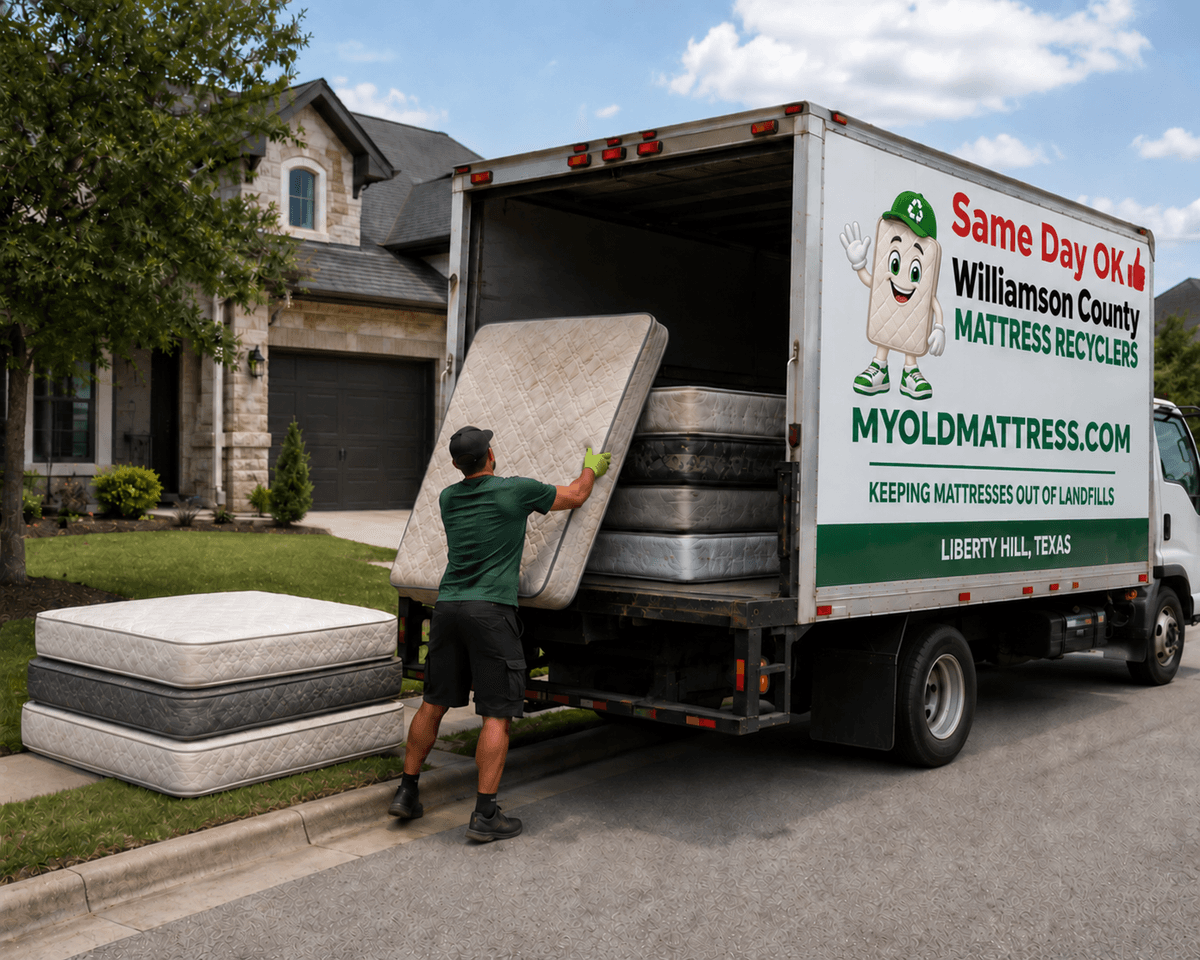
Every year, an estimated 18 to 20 million mattresses are discarded across the United States. Most of them end up in landfills — not because recycling is impossible, but because it is inconvenient. For Leander residents, that equation has changed. Mattress recycling pickup in Williamson and Travis Counties is now as simple as booking online and leaving your mattress at the curb.
But beyond the convenience, there is a real environmental story worth understanding. What actually happens when a mattress goes to a landfill? What happens when it gets recycled instead? And why does it matter to communities like Leander, Cedar Park, and the broader Williamson County area? This post walks through all of it — clearly, honestly, and without the greenwashing.
Why Mattresses Are Such a Stubborn Landfill Problem
A mattress is not like a cardboard box or an aluminum can. It is a composite product — layers of foam, springs, fabric, wood, and sometimes adhesives — all bonded together into a single oversized object that resists both compaction and decomposition.
When a mattress goes to a landfill, it creates several distinct problems:
- Volume: A standard queen mattress occupies roughly 25 to 30 cubic feet of landfill space. It does not compact easily, which means it displaces a disproportionate volume relative to its weight.
- Slow decomposition: Polyurethane foam — the material in most modern mattresses — can take decades to break down. During that time, it sits largely intact underground.
- Spring rebound: Coil spring systems tend to expand and shift over time in a landfill, damaging liner systems and creating uneven settling that complicates landfill management.
- Leachate risk: As mattress materials degrade, they can leach synthetic compounds into surrounding soil. While the risk varies by mattress age and composition, it is a documented concern for older foam and fire-retardant-treated materials.
According to the EPA's facts and figures on materials, waste, and recycling, furniture and furnishings — a category that includes mattresses — represent one of the largest non-food categories of municipal solid waste sent to landfill every year. The scale of the problem is not trivial.
What a Recycled Mattress Actually Contains
One of the reasons mattress recycling has grown as an industry is that a mattress is surprisingly rich in recyclable materials. When our facility processes an old mattress, here is what comes out of it:
Steel Springs
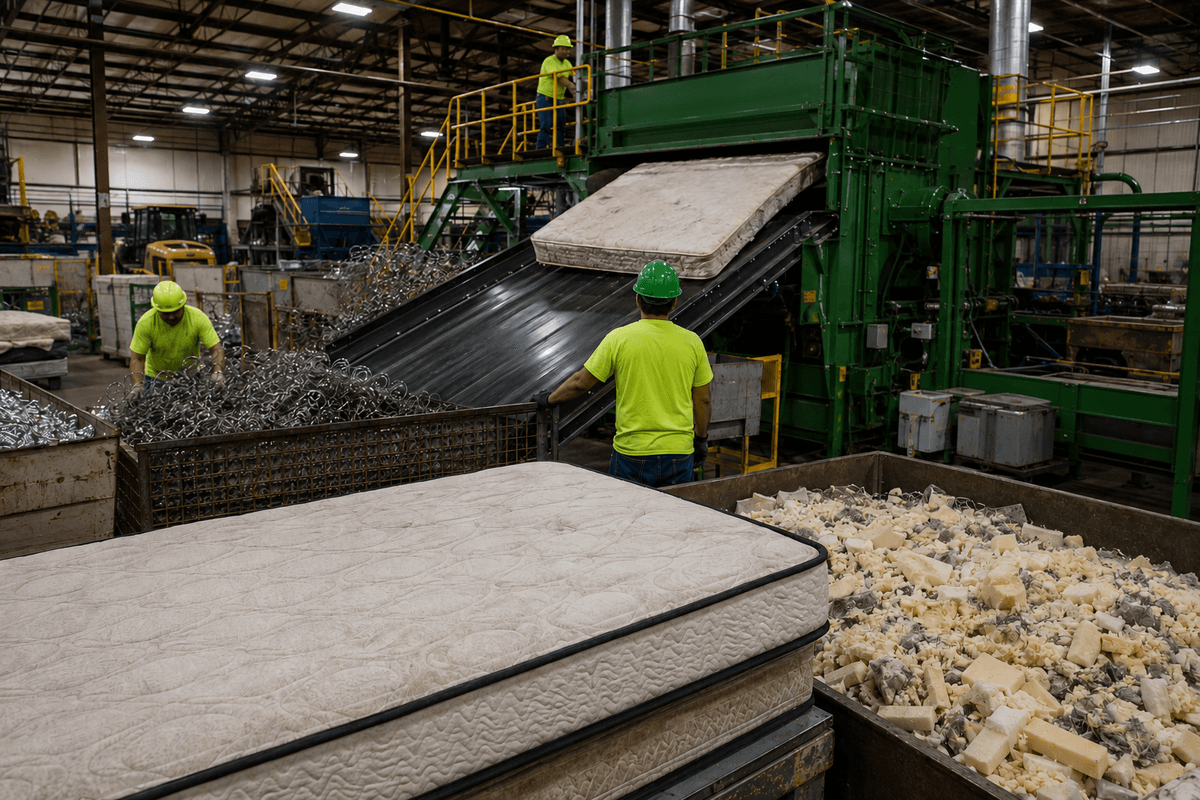
Innerspring and hybrid mattresses contain a significant volume of steel coils. Steel is one of the most efficiently recycled metals in existence — it can be melted down and recast indefinitely without loss of quality. The steel from a single queen innerspring mattress can weigh several pounds, and it goes directly into the scrap metal stream.
Polyurethane Foam
Foam is the bulk material in most modern mattresses, including memory foam and standard comfort layers. Recycled foam has multiple end-use markets: carpet underlayment, gym mats, industrial padding, and — as we do here at Williamson County Mattress Recyclers — stuffing for dog beds donated to animal shelters and rescues. Learn more about our shelter dog bed program and how your old mattress helps local animals.
Wood Foundations and Frames
Box springs and foundation mattresses often include a wood frame. Recycled wood gets chipped into mulch, used in particle board manufacturing, or processed for biomass energy — all outcomes that keep it out of a landfill.
Cotton and Natural Fiber
Older mattresses frequently include quilted cotton batting and natural fiber layers. These materials can be processed into industrial wiping cloths, insulation fill, or other textile recycling streams.
Synthetic Fabric Covers
The outer ticking — the fabric cover on the outside of the mattress — can be sorted and processed as a textile. Clean, intact fabric in good condition can be repurposed; heavily soiled fabric goes into fiber recycling.
The key insight: a mattress that looks like trash is actually a bundle of raw materials. Recycling recovers 80 to 90 percent of its components by weight in many cases. That recovery rate is what makes mattress recycling environmentally meaningful, not just symbolically satisfying.
The Landfill Alternative: What Leander Residents Are Avoiding
When a Leander homeowner drags a mattress to the curb for standard bulk trash pickup, one of two things typically happens: it goes to a regional landfill, or it gets illegally dumped by someone who picks it up for that purpose but lacks a proper disposal facility. Neither outcome is good.
Regional Landfill Pressure in Central Texas
Williamson County and the greater Austin metro have experienced significant population growth over the past decade. More residents means more waste volume, and landfill capacity in Central Texas is not unlimited. Every mattress that avoids the landfill is a small but real contribution to extending the life of existing regional waste infrastructure. When multiplied across thousands of households, that adds up.
Illegal Dumping and Community Blight
Mattresses are one of the most commonly illegally dumped items in suburban and rural areas — not because people are careless, but because legal disposal options are genuinely inconvenient. In Leander and surrounding communities, an old mattress sitting in a vacant lot or along a rural road creates an eyesore, attracts additional dumping, and costs municipalities money to remove. Making legal recycling easy and affordable is one of the most direct ways to reduce illegal dumping of mattresses in any community.
Mattress Recycling vs. Donation: Understanding the Difference
A common first instinct when getting rid of a usable mattress is to donate it. That is an admirable impulse, but the reality of mattress donation is more complicated than it seems.
- Most thrift stores and charities do not accept used mattresses, due to health codes, bed bug risk, and liability concerns. Goodwill, Salvation Army, and similar organizations in Central Texas routinely decline mattress donations.
- Mattresses in poor condition — stained, torn, heavily worn — have no donation pathway. They need to be recycled or disposed of, full stop.
- Even "clean" mattresses often get rejected because donation centers cannot easily inspect for hidden pest activity or hygienic issues invisible to the naked eye.
Recycling is the responsible default for any mattress that is no longer being used, regardless of its apparent condition. Our service picks up mattresses in any condition — stained, torn, or simply worn out — because condition does not affect recyclability. Check out our frequently asked questions about mattress recycling for more detail on what we accept.
How the Recycling Process Works, Step by Step
Transparency matters when you are making an environmentally motivated decision. Here is what actually happens after we pick up a mattress in Leander:
- Curbside pickup: You schedule online, choose your pickup day, and leave the mattress curbside or in your driveway. No need to be home. No hauling required on your part.
- Transport to our facility: We load and transport mattresses to our recycling facility, where they are processed — not simply resold or re-dumped.
- Deconstruction: At the facility, mattresses are broken down by hand or with specialized equipment. The outer fabric is removed first, then foam layers are separated, then springs are extracted, and wood components are pulled out.
- Material sorting: Each material type is sorted and staged for its specific recycling stream — steel to scrap dealers, foam to padding and stuffing applications, wood to mulch or biomass, fabric to textile recyclers.
- Dog bed production: Where clean, suitable foam and fabric materials exist, we repurpose them into large dog beds, which are then donated to animal shelters and rescue organizations in our area.
- Documentation and diversion: The mattress is diverted from landfill. Nothing ends up in a dumpster after the recycling process is complete.
If you want to understand what to expect from the full experience as a customer, our blog post on mattress recycling from start to finish walks through every step in detail.
The Carbon Footprint Angle: Why Material Recovery Matters
Recycling is not only about keeping materials out of landfills. It is also about reducing the energy and carbon cost of producing new materials from scratch.
Consider steel: producing new steel from raw iron ore is enormously energy-intensive. Recycling scrap steel uses approximately 60 to 70 percent less energy than producing virgin steel, according to industry benchmarks cited by the EPA's recycling overview. When the steel springs from thousands of mattresses flow back into the scrap metal market, that is a real and measurable reduction in energy demand.
The same logic applies to foam. Manufacturing polyurethane foam is a petrochemical-intensive process. Recovering and reusing existing foam — even in secondary applications like carpet underlayment or stuffed dog beds — reduces the demand signal for new foam production.
At the household level, the carbon benefit of recycling a single mattress is modest. At the community scale, across thousands of pickups per year, it becomes part of a meaningful regional contribution to reduced material production emissions.
Leander's Growth and Why Local Recycling Options Matter Now
Leander has been one of the fastest-growing cities in Texas for several years running. New neighborhoods, new developments, and a rapidly expanding population mean a corresponding increase in household turnover — and household turnover means more old mattresses entering the waste stream.
When families move into a new home or upgrade their sleep setup, old mattresses need to go somewhere. Without a convenient, affordable local recycling option, most of them default to landfill. The availability of curbside mattress recycling pickup in Leander directly addresses that gap, making it as easy to do the right thing as it is to do the wrong one.
Our complete Leander mattress recycling guide for 2026 covers local disposal rules, timing, and how our pickup process works specifically for Leander addresses.
Mattress Sizes and What Each Contributes to Landfill Diversion
We pick up every mattress size — and the environmental impact scales with the size of the mattress being diverted from landfill. Here is a quick breakdown of what each size contributes:
- Toddler/crib mattress: Smaller volume, but often made with denser foam. Toddler mattress pickup keeps a compact but long-lasting synthetic material out of landfill.
- Twin mattress: A common single-bed size that turns over frequently in college households and children's rooms. Twin mattress recycling serves a high-volume segment of the Leander market.
- Full mattress: Mid-range in both size and material volume. Full mattress pickup is common for guest rooms and smaller bedroom footprints.
- Queen mattress: The most common mattress size in U.S. households. Queen mattress recycling represents the largest single category of material we divert.
- King mattress: The largest standard size, with the highest material volume per unit. A recycled king mattress contributes the most foam, steel, and fabric per pickup. King mattress pickup is available throughout our service area.
Every size we handle gets the same thorough recycling process — nothing is oversized enough to skip the line.
The Shelter Dog Beds Program: A Second Life for Mattress Materials
One of the things that makes our approach genuinely different is where recyclable foam and fabric go after deconstruction. Clean, suitable materials are repurposed into large, comfortable dog beds, which we then donate to animal shelters and rescue organizations in Williamson and Travis Counties.
This means your old mattress could literally end up as a warm, soft bed for a shelter dog waiting for a forever home. That is not a marketing abstraction — it is a physical, local outcome that happens with every load of clean foam and fabric we process.
The environmental logic is straightforward: instead of sending foam to a landfill and purchasing new materials to make dog beds, we close the loop. Recycled foam becomes a useful product, a useful product gets donated to a local cause, and landfill diversion happens at both ends of the transaction.
Read more about the shelter dog beds program and the organizations we support.
Common Misconceptions About Mattress Recycling
A lot of well-meaning people have incorrect assumptions about mattress disposal. Here are the most common ones we hear, and the reality behind each:
"My mattress is too old or too dirty to recycle."
False. The recycling process is about material recovery, not resale. A stained or torn mattress still contains fully recyclable steel, foam, and wood. Condition is irrelevant to recyclability. We accept mattresses in any condition, period.
"The city bulk pickup already recycles mattresses."
Not necessarily. Bulk trash pickup in most Central Texas municipalities sends mattresses to a municipal solid waste landfill, not a recycling facility. Unless the pickup specifically contracts with a mattress recycler — which most do not — your mattress is going to the landfill even if it is collected separately from other trash.
"One mattress does not make a difference."
This is the tragedy-of-the-commons framing applied to recycling, and it is worth pushing back on. One mattress recycled is 25-plus cubic feet of landfill space preserved, several pounds of steel recovered, and potentially a dog bed donated to a shelter. Multiply that by a community of Leander's size, and the aggregate impact is real. Individual decisions aggregate into community outcomes.
"Recycling costs too much to be worth it."
We understand cost is a real concern. Our pricing is designed to be affordable for Williamson and Travis County residents — and it is almost always less expensive than renting a truck and hauling a mattress yourself, which also comes with the ergonomic risk of lifting an awkward, heavy object. Speaking of which, OSHA's ergonomics guidance makes clear that improper manual lifting of heavy, bulky items is a common source of back and shoulder injuries. Let us handle it. See our mattress recycling cost guide for Leander for current pricing details.
How to Prepare Your Mattress for Pickup
Preparation is minimal — that is by design. But there are a few things you can do to make the process smooth:
- Remove all bedding: Sheets, mattress protectors, and pillows are not part of the pickup. Remove them before your scheduled day.
- Place the mattress where we can access it without entering your home: Curbside is ideal. Driveway works great. Just inside a back yard gate is fine. We cannot enter interior living spaces.
- No need to bag or wrap it: We accept bare mattresses. You do not need to wrap it in plastic or cover it in any way.
- Double-check your pickup window: You will receive a confirmation with your scheduled pickup day. You do not need to be home — just make sure the mattress is accessible during the pickup window.
That is genuinely all there is to it. If you have multiple mattresses to recycle, contact us to discuss multi-unit pickups or commercial recycling services for higher volumes.
Why Leander Homeowners Are Choosing Recycling Over Landfill in 2026
The shift in consumer preference toward responsible disposal is real and measurable. Homeowners in Leander, Cedar Park, and across Williamson County increasingly want to know where their discarded items end up — and they are willing to pay a modest fee to ensure the outcome is a good one.
This is not limited to mattresses. It reflects a broader pattern in how suburban Central Texas residents think about consumption and disposal. The same household that shops for energy-efficient appliances — ENERGY STAR-rated ones, specifically — is also more likely to ask whether there is a recycling option before defaulting to landfill disposal.
For mattresses specifically, the recycling option has historically been hard to find and inconvenient to use. A curbside pickup model that requires nothing more than booking online and leaving the mattress accessible removes the friction that previously kept recycling rates low.
Our story and mission grew directly from that observation: a mattress is one of the hardest household items to dispose of responsibly, and Williamson County needed a better option. We built one.
Frequently Asked Questions
What environmental impact does recycling a mattress in Leander, TX actually have?
Recycling a single mattress keeps roughly 25 to 30 cubic feet of material out of a regional landfill, recovers multiple pounds of steel for reuse, and recaptures foam for secondary applications like carpet padding or donated dog beds. Multiplied across a growing community like Leander, the aggregate impact on landfill capacity, raw material demand, and community blight from illegal dumping is genuinely significant. The EPA notes that material recovery through recycling reduces both landfill pressure and the energy demand for producing new materials from scratch.
Will Williamson County Mattress Recyclers pick up a mattress in any condition?
Yes. We accept mattresses in any condition — stained, torn, water-damaged, or simply worn out. The recycling process is about material recovery, not resale. The steel springs, foam, wood, and fabric in a heavily used mattress are just as recyclable as those in a lightly used one. You do not need to clean, bag, or prepare the mattress in any special way before your scheduled pickup.
How is your recycling pickup different from Leander's bulk trash service?
Most municipal bulk trash programs in Central Texas dispose of mattresses at a standard solid waste landfill, not a dedicated recycling facility. When you schedule with us, your mattress goes to our recycling facility, where it is deconstructed and its components — foam, steel, wood, and fabric — are separated and directed to appropriate recycling streams. Nothing we collect ends up in a landfill. That is the core difference.
What sizes of mattresses do you pick up in Leander?
We pick up every standard mattress size: toddler and crib, twin, full, queen, and king. All sizes receive the same full recycling process at our facility. Size does not affect eligibility for pickup — only the volume of materials recovered at the end. If you have multiple mattresses to recycle, contact us to discuss scheduling or pricing for multi-unit pickups.
How does the shelter dog bed program work?
After we deconstruct a mattress, clean and suitable foam and fabric are repurposed into large, comfortable dog beds rather than being discarded. We then donate those beds to animal shelters and rescue organizations in Williamson and Travis Counties. It is a closed-loop use of recycled materials that gives your old mattress a second life benefiting local animals waiting for adoption. Not every mattress yields usable fabric — but when it does, those materials go directly to this program.
Is mattress recycling pickup in Leander expensive?
Our pricing is designed to be affordable for Williamson and Travis County residents. When you factor in the cost and hassle of renting a truck, the ergonomic risk of moving a heavy, bulky item yourself, and potential dump fees, curbside pickup recycling is frequently comparable to or less than the do-it-yourself alternative. See our detailed breakdown in the mattress recycling cost guide for Leander for current rates.
Do I need to be home when you pick up the mattress?
No. You do not need to be present during pickup. Simply place the mattress curbside, in your driveway, or just inside an accessible gate before your scheduled pickup window. As long as we can access the mattress from outside your home without entering interior living spaces, the pickup will proceed as scheduled. You will receive a confirmation with your pickup day when you book online.
Ready to Schedule Your Leander Mattress Recycling Pickup?
Getting rid of an old mattress does not have to mean adding to a landfill. For Leander homeowners, there is a straightforward alternative: book online, leave your mattress accessible, and let us handle the rest.
Your old mattress gets recycled the right way — steel recovered, foam repurposed, wood reclaimed — and if the materials are suitable, it helps provide a comfortable bed for a shelter dog waiting for a home.
Visit our mattress recycling pickup service page to book your pickup today. If you have questions first, our FAQ page covers everything you need to know — or reach out directly and we will get back to you promptly.
One pickup. Real recycling. A little good done for Leander and the animals that call it home.